


How Edge Impact and the Restaurant Association of New Zealand are tackling food waste
Kai Keepers Pilot: Fighting Food Waste in Aotearoa
The Challenge
Each year, Aotearoa’s cafes and restaurants generate nearly 25,000 tonnes of food waste, with 61% of it entirely avoidable.
When food ends up in landfill, it’s not just an environmental loss, it’s a missed opportunity to enhance sustainability within the hospitality industry and boost financial outcomes for operators.
After two years of measurement and testing, the programme’s third year shifted focus to communicating the results, engaging stakeholders and translating these insights into practical guidance.
Key deliverables year 3 - Scale up to industry
Results and findings public report
Presentation of results to participating businesses
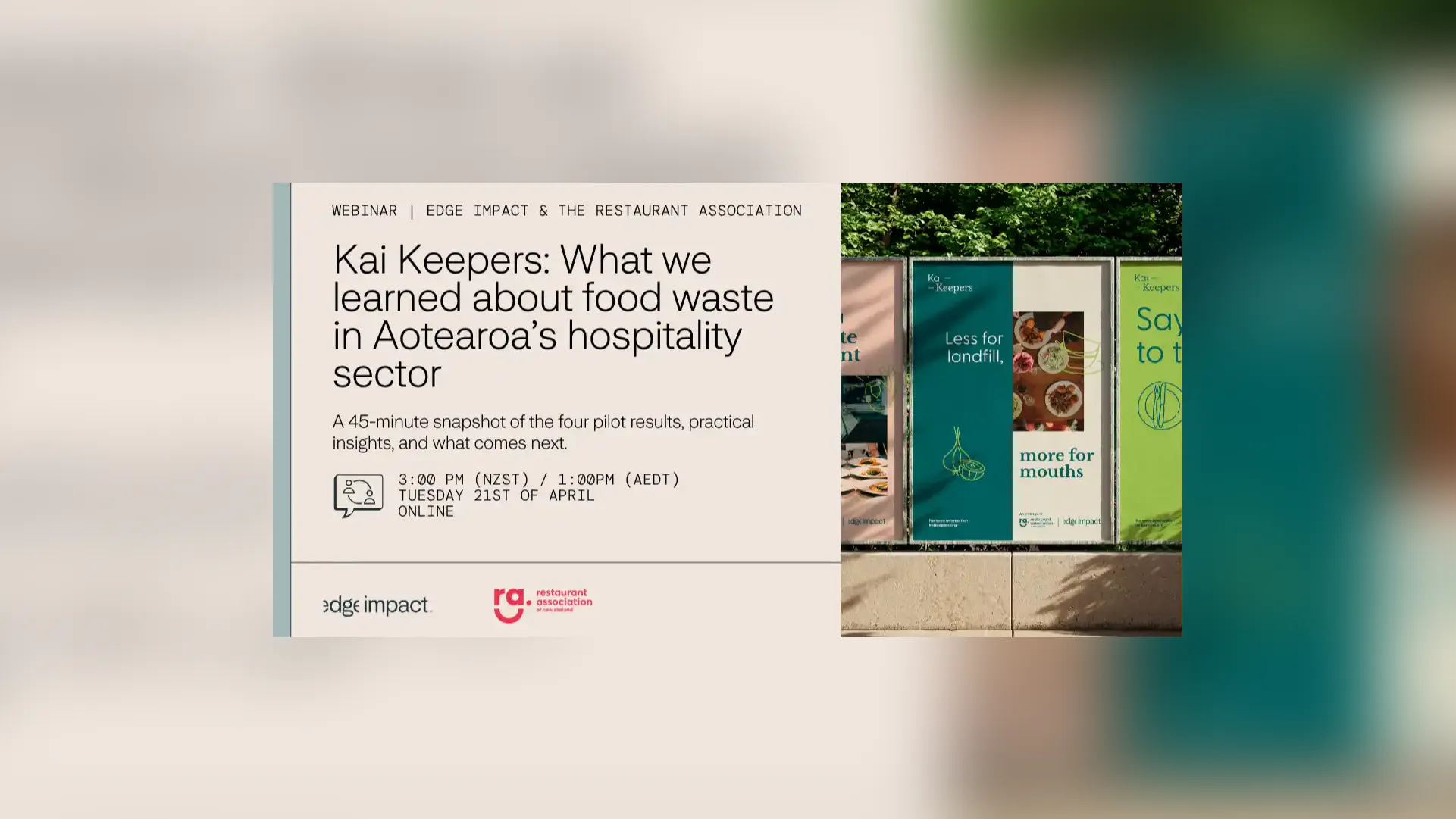
Hosted industry webinar for New Zealand and Australia
The Approach
To tackle this pressing issue and generate actionable data across the industry, the Restaurant Association, in conjunction with Edge Impact, launched the Kai Keepers pilot. This initiative set out to transform food waste practices across cafés and restaurants in Auckland, Bay of Plenty and Waikato.
Funded by New Zealand’s Ministry for the Environment, Kai Keepers supports hospitality businesses to reduce food waste, helping operators achieve sustainability goals while unlocking measurable financial savings.
The two-and-a-half-year programme engaged 120 participants and was delivered in two stages. The first stage established a baseline, measuring food waste volumes and identifying key drivers across participating businesses. The second stage tested a series of targeted interventions designed to reduce food waste in real-world settings.
These interventions focused on four key areas:
- Adjusting portion sizes to reduce plate, preparation and spoilage waste
- Reusing preparation waste to create new dishes
- Upselling at-risk stock to prevent spoilage
- Redirecting unsold food for staff use
In its third year, the programme shifted from testing interventions to communicating results and enabling wider industry adoption. This phase focused on analysing results from across both stages to assess the effectiveness of each intervention and understand the conditions that support successful implementation.
The resulting report draws on both quantitative and qualitative evidence to measure changes in food waste, compare outcomes across businesses and evaluate intervention performance. Insights were also shared directly with participating businesses and presented through industry engagement activities, including a webinar for New Zealand and Australia, to support broader awareness and uptake.
Together, these efforts provide a strong evidence base and a clear pathway for scaling effective food waste reduction practices across the hospitality sector.
The Result
Reducing food waste delivers clear financial benefits. The average hospitality business could potentially save $5,520 per year through improved food waste practices.
Across all initiatives, food waste per cover reduced from 134 grams to 112 grams, representing a 16.4 percent reduction across the programme. While this may seem small at an individual level, it becomes significant at scale.
Each month, this reduction equates to more than 5 tonnes of food waste avoided, preventing over 6 tonnes of emissions and delivering meaningful cost savings for participating businesses.
All four interventions contributed to this outcome, with the strongest results achieved where actions directly targeted the source of waste.
Smaller and flexible portion sizes delivered the strongest overall performance, reducing total food waste by 20.6 percent per cover. This was driven by a 43 percent reduction in preparation waste and a 33 percent reduction in spoilage.
Reusing preparation waste to create new dishes reduced total food waste by 17.5 percent, with a 55 percent reduction in prep waste. This intervention highlighted the value of rethinking kitchen processes and using ingredients more efficiently.
Upselling at-risk stock achieved a 20 percent reduction in total food waste per cover and delivered the largest proportional reduction in spoilage, cutting it by 50 percent. This demonstrated the effectiveness of engaging front-of-house staff in waste reduction efforts
Redirecting unsold food reduced total food waste by 17 percent per cover, with 70 percent of venues reporting an overall reduction in waste. On average, 704 grams of food per day was redirected per venue, helping recover value that would otherwise be lost

Importantly, improvements were observed across all major waste categories, including preparation, plate and spoilage waste. Even businesses that did not implement targeted interventions reduced waste through increased awareness and measurement alone.
Interventions worked best when they aligned with existing workflows, and combining them increased impact. Messaging also influenced uptake, with staff responding more to framing around quality, efficiency and ingredient care. Peer learning further strengthened outcomes by supporting knowledge sharing between businesses.
The findings provide a clear pathway for scaling impact across the sector. This includes expanding the most effective interventions, strengthening industry engagement and embedding food waste reduction into everyday operations.
Focus Group Participants
"There was lots of momentum behind it... it felt like it had strength."
“Loved being part of this great initiative. The trickle down affect has been long lasting for our business and unified our team in our efforts to reduce food waste.”
“Loved being part of this great initiative. The trickle down affect has been long lasting for our business and unified our team in our efforts to reduce food waste.